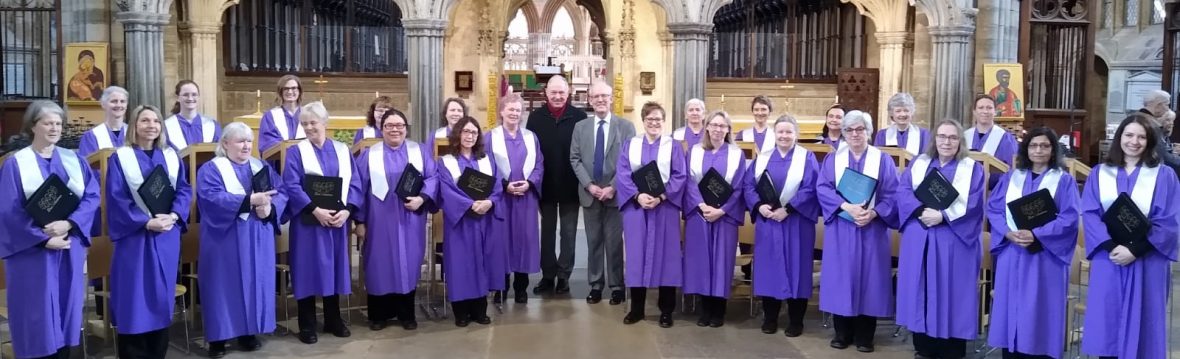


I was delighted and very touched to learn that my fellow choir members had chosen the Noonan Syndrome Association (NSA)[1] as the charity the choir will be supporting through concerts and fundraising events over the course of the next year. Since learning that our youngest child (who is now two and a half) has Noonan Syndrome (NS), my husband and I have recently become more involved with the work of the charity – he as a trustee and I as a volunteer.
Noonan Syndrome is one of a family of genetic conditions known as RASopathies. It has been described as “the most common rare disease you’ve never heard of”[2] and we certainly had not heard of it until our son’s diagnosis. It is estimated to affect 1 in 1000 births. Choir members may remember the concerns and scares we faced during my pregnancy and also the worrying period of time during our son’s first year of life when every doctor we saw knew that there was something wrong but could not tell us what. In the absence (thankfully) of a heart condition and faced with problems that in isolation are not unusual in infants (poor feeding, reflux and vomiting, failure to thrive), it was only when we were referred to see a paediatrician and then a paediatric specialist, after a concerning set of blood test results, that the possibility of Noonan Syndrome was mentioned to us. Subsequent genetic testing confirmed this to be the case. From that point onwards things began to make sense as we pieced together the many parts of the puzzle. We have since learned that NS is the most common single gene change to cause an increased nuchal thickness measurement on the 12 week anomaly scan during pregnancy – chromosome testing is normal in these cases and yet it is estimated that 1 in 10 of those “normal” results will yield a genetic result of Noonan Syndrome.[3] This is exactly where our story started.
Following this diagnosis we have been on quite a journey of educating ourselves about the condition and about the best way to support our son physically, socially and emotionally as he grows up. This is where the Noonan Syndrome Association has been invaluable in providing guidance and education for families like ours, faced with a diagnosis that is often unfamiliar to many medical professionals and where there is no one clear “road-map” for management. The nature of Noonan Syndrome is such that each individual is affected differently in breadth and severity, even where the genetic diagnosis is the same. NS is a condition that has now been found to be associated with changes in any one of several different genes, each one linked to the RAS/MAPK signalling pathway. In our son’s case, he did not inherit this condition, but rather a genetic change occurred sporadically (or De novo, which accounts for the majority or nearly two thirds of NS cases). Noonan Syndrome (named after the cardiologist Jacqueline Noonan) was initially thought to be a condition defined by serious heart conditions combined with physical features such as short stature, but over the course of more recent years, while a large proportion of people with NS do have a heart condition, a much wider spectrum of symptoms have become recognised, which are often just as concerning for families and individuals. The importance of having a team of medical and healthcare as well as educational professionals to monitor and support health and development in NS cannot be underestimated, particularly where early intervention can make such a difference. We are lucky also to be able to attend a specialist clinic at Great Ormond Street Hospital, which is supported by the NSA.
Along with my husband, I am incredibly grateful to the choir for the opportunity to fundraise for the Noonan Syndrome Association and to raise awareness of this condition. Singing has always been an outlet for me and singing with Bra-vissima has certainly played a role in getting through some challenging times over the past few years. Our little boy and his big sister love music and singing too – something which always brings smiles to their faces and ours – so we can’t think of a better way to support the charity!
J. Milne 15/05/26

Design by our daughter (age 6) for a NSA competition last summer
[1] https://www.noonansyndrome.org.uk/
[2] https://www.lboro.ac.uk/news-events/videos/2024/noonan-syndrome/
[3] Shiels KA et al., Noonan Syndrome : immeasurably more than height and heart, Paediatrics and Child Health, https://doi.org/10.1016/j. paed.2026.02.003
